En tur till Djävulsbron...'Pont du Diable'
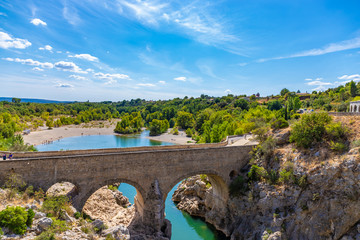
Det blir ingen komplett resa utan ett besök till stranden vid Djävulsbron...Pont du Diable som byggdes under 1000-talet över floden Hérault. Bron var konstruerad av en Benediktinsk munk med syftet att skapa en brygga mellan klostret Aniane och klostret Gellone vid byn Saint-Guilhem-le-Désert. Det franska ministeriet har stämplat bron som ett historiskt monument (1935) och den är även med på UNESCO världsarvslista - vilket också byn är.
Som kuriosa är bron en del av Routes of Santiago de Compostela...
Enligt en legend så härjade djävulen i trakten och odjuret lovade munkarna att han skulle förpesta tillvaron för människorna i byarna om de inte skänkte honom en själ av den första levande varelsen som gick över bron. Munkarna skickade över en skraltig byracka som djävulen var tvungen att ta som överenskommet. Den hornbeprydda kände sig grovt lurad och i sina ilskna fäktanden trillade han ner från bron och försvann utan att bli sedd därefter.





No trip would be complete...
...without a visit to the beach at the Devil's Bridge...Point du Diable, built in the 11th century over the Hérault River. The bridge was designed by a Benedictine monk with the aim of creating a bridge between the monastery of Aniane and the monastery of Gellone near the village of Saint-Guilhem-le-Désert. The French Ministry has designated the bridge a historical monument (1935) and it is also on the UNESCO World Heritage List, as is the village itself.
As a curiosity, the bridge is part of the Routes of Santiago de Compostela...
According to legend, the devil was ravaging the area and promised the monks that he would plague the people in the villages if they did not give him the soul of the first living creature to cross the bridge. The monks sent over a scrawny old woman, whom the devil was forced to take as agreed. The horned creature felt cheated and in his angry struggle he fell from the bridge and disappeared without being seen again.
On Tuesday (8 July), we chose the quiet part of the beach. The beach is called “plage” [or, as my sister's husband bluntly pointed out, we are in the country of plage and pain] and has a car park with barriers, a wine shop with outdoor seating and a bookstall where we can pick up (French) books for free – or fairly free. Our conscience demands that we at least occasionally give a few books in exchange.
If you continue by car, over the bridge towards the village of Saint-Guilhem-le-Désert and stop at the side of the road, there are absolutely wonderful, paradise-like cliffs to swim from!
Adrian, our son, is currently reading August Strindberg's book Among French Peasants:
Adrian told us that Strindberg, in his capacity as a journalist, apparently visited Languedoc in 1885-1886 and wrote:
‘This was the land of desolation and death, and we, who had never seen Africa, believe we have gained a faint impression of it in its worst manifestation.’ (p. 163)
During the period he was travelling, phylloxera, an aggressive aphid that attacks grapevines, had spread and destroyed one vineyard after another. He also wrote:
"Beyond a heath of Spanish broom and tree-high tamarisk trees, the Mediterranean finally appears as a blue streak. The occasional pine tree seems to confirm its identity, and when we pass the salt flats at Onglous [where Fredrik and I usually walk] with their white pyramids of salt, the blue sea with its countless sails lies completely open to the train, which runs on a slight promontory at the edge of the sea until it reaches Cette." (p. 163)
It was a lovely day at the beach, but Strindberg's words took on a fateful tone as we sped towards Marseillan with Molly.
On the way home, another fire had broken out... this time near our village. We followed the ominous smoke all the way into the heart of the village.
It billowed and curled over the church like an evil spirit. We could even see it from our roof terrace.
Back to homepage:


Kommentarer
Skicka en kommentar